
The Art of Integration: Conducting the Orchestra of Project Delivery
Walk into a concert hall just before a performance begins.
Musicians are arriving, unpacking their instruments, tuning independently. A violin tests a high note. A trumpet cuts through the air. Percussion tries a rhythm.
Everything sounds right.
Everything is done by experts.
And yet… it doesn’t work.
Because together, it is not music—it is noise.
And many projects spend most of their lifecycle operating exactly in that state.
Only when a shared score is followed—when someone aligns timing, intent, and sequence—does that noise transform into something powerful: a single, coherent performance.
Large capital projects often begin in exactly the same way.
Recently, the AWP Community for Business Advancement (CBA) gathered to explore a topic that sits at the heart of project performance: the art of integration.
It is a concept that everyone recognizes—yet few can clearly define, and even fewer consistently achieve. Engineering advances designs. Procurement secures equipment. Construction prepares to execute. Each discipline performs well individually—but without integration, the result can feel fragmented, reactive, and unpredictable.
The art of integration is what transforms that noise into harmony.
The Reality of EPC Integration
In practice, integration across engineering, procurement, and construction (EPC) is not simply coordination—it is alignment of timing, logic, and data.
Projects repeatedly encounter similar challenges:
- Work packages are not fully tied to schedule activities or cost reporting, limiting visibility of true progress
- Engineering, procurement, and construction operate on different rhythms, creating disconnects in decision-making
- Work breakdown structures are defined without reflecting how work will actually be executed in the field
- Packaging and constructability considerations arrive too late to influence outcomes
These are not failures of discipline—they are failures of integration. They emerge when each function optimizes its own performance instead of contributing to a common outcome.
.png?language=en-US "Work-Packaging-Image-(2).png")
The Common Language: Work Packaging
If integration is the art, work packaging is the language.
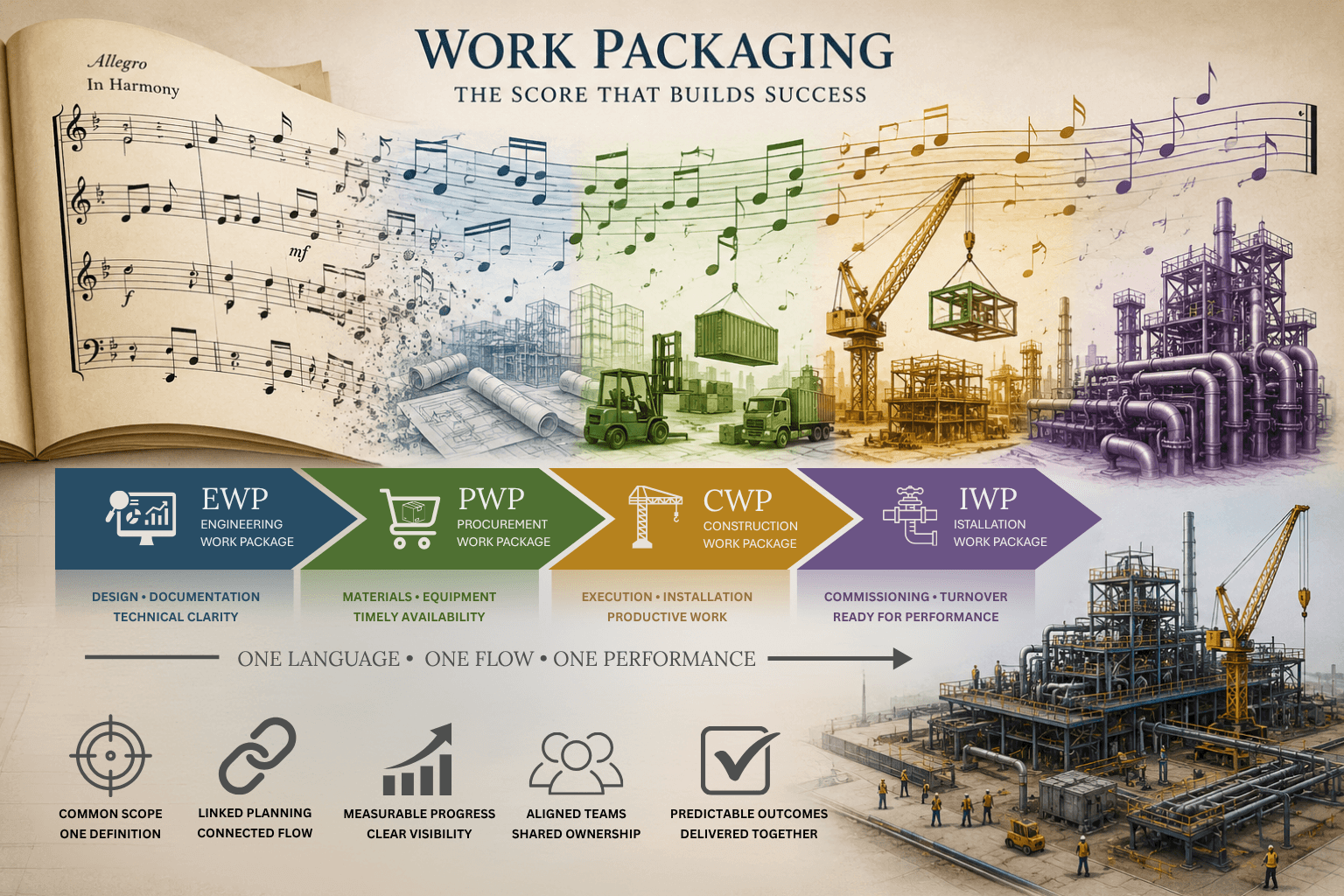
Work packages—engineering (EWP), procurement (PWP), construction (CWP), and installation (IWP)—provide a structured way to connect scope, sequence, and execution across the project lifecycle. But their value is not in their existence—it is in how they are structured and aligned.
When done well, work packaging creates:
- A shared definition of scope across all stakeholders
- A clear link between planning and execution
- A consistent framework for measuring progress
Without this shared structure, each function writes its own “score.”
With it, the project begins to move as one.
Structuring Integration: A Common Framework for Packages
One of the ongoing initiatives within the AWP CBA is focused precisely on this challenge: defining a consistent and practical structure for work package identification and alignment across projects.
This approach organizes work package definitions into structured elements—such as:
- Work areas and sub-areas
- Disciplines
- Types of work
- Sequential identifiers
- Optional project or contract references
This is not about naming for compliance—it is about enabling integration. It serves several critical purposes:
1. A Package That Works for Everyone
A work package must simultaneously support engineering, procurement, scheduling, and construction—not just one discipline.
2. Clarity and Interoperability
A consistent structure allows systems, schedules, and teams to “speak the same language,” supporting alignment across tools and data sources.
3. Flexibility for Real Projects
Projects are not uniform. This structure enables both one-to-one and one-to-many relationships between packages, adapting to execution strategy rather than constraining it.
4. Usability for People
These structures are used daily in real decisions. Clarity, simplicity, and readability are essential for adoption and effectiveness.
This is more than structure—it is the foundation that allows integration to exist.
Bringing Integration into the Schedule
Structure alone is not enough. Integration must be visible in how projects are planned and controlled.
This is where the industry research effort RT‑433: Project Controls for AWP, to be presented at the CII Annual Conference this summer, becomes critical.
The work highlights that what true integration requires:
- A single, unified master schedule using a common language
- Work packages treated as schedule activities, not just references
- A schedule driven by the path of construction, not only design logic
- Frequent updates aligned with field execution, matching the pace of the site
Importantly, integration does not mean forcing artificial alignment.
For example, procurement strategies should support construction but do not need to mirror construction packages one-to-one. Bulk purchasing may cross multiple packages while still aligning with installation priorities.
Integration respects reality—it does not simplify it away.
Beyond Systems: The Human Element
No framework alone can deliver integration.
It requires:
- Early collaboration across disciplines
- Shared ownership of project outcomes
- A shift from siloed thinking to integrated execution
Just like in an orchestra, alignment is not just about the sheet music—it is about how people perform together.
Closing: From Noise to Harmony
At its core, the art of integration is about coherence.
It is ensuring that:
- Engineering delivers what construction needs—when it is needed
- Procurement supports the sequence—not disrupts it
- Schedules reflect reality—not aspiration
When this happens, projects fundamentally change.
They move from reactive… to predictable.
From fragmented… to aligned.
From effort… to flow.
From noise… to music.
And from coordination… to true integration.
Because, like any great performance, success is never defined by individual excellence alone—but by the system that brings everything together, at the right moment, in perfect harmony.
Acknowledgment
Prepared by the AWP CBA Leadership Team
Lead Author & Chair: Dario Rigaud
Vice Chair: Danny Morrison
Academic Advisor: Vassilina Demetracopoulou
CII Senior Project Manager: Shannon Brinkley


.png?language=en-US)
_1.png?language=en-US)